TrailChat — Offline Messaging with ESP32-S3 and NRF24
Project Overview
TrailChat is a portable wireless communication project that allows two people to exchange text messages and small photos without internet, a SIM card, or mobile network coverage.
The project explores an alternative way to stay connected while trekking, camping, or visiting remote areas. In mountain and forest regions, mobile coverage can be unavailable. TrailChat creates a direct radio link between two devices, provided they remain within usable radio range.
Each person carries an ESP32-S3 connected to an nRF24L01+ radio module. Their phone connects to that device’s local Wi-Fi network and opens a browser-based chat interface. The two devices then exchange messages over NRF radio.
The phones do not need a shared hotspot, a router, or an installed messaging application. Each phone communicates with its own device, and the devices carry the conversation between them.
Project Objectives
Build a two-person messenger that operates without internet access.
Use ordinary smartphones as the display and keyboard.
Exchange messages through a direct NRF radio link.
Support compressed photo previews alongside text.
Provide clear connection status and transfer feedback.
Explore the practical limits of portable radio communication outdoors.
Key Features
Send and receive messages without a cloud server.
Hardware Required
Esp32s3
Offline Text Messaging:
Photo Sharing: Send a small JPEG preview compressed by the phone’s browser.
Independent Wi-Fi Networks: Each ESP32-S3 creates its own access point.
Browser-Based Interface: Open the chat page without installing an app.
Two-Way Communication: Either person can initiate a message when the link is idle.
Transfer Progress: View the progress of an outgoing transfer.
Delivery Confirmation: Confirm that the receiving device accepted the complete content.
Retries and Checksums: Retry missing packets and verify reassembled content.
Serial Diagnostics: Check local NRF detection, peer activity, phone connection events, and transfer results.
Portable Power: Power each ESP32-S3 development board from USB, including a suitable power bank.
How the System Works
The system uses two separate wireless links:
| Wireless Link | Purpose |
| --- | --- |
| Phone to ESP32-S3 over Wi-Fi | Opens the local chat page and submits or displays content |
| ESP32-S3 to ESP32-S3 over NRF radio | Carries messages and photos between the two devices |
Sending a message:
Phone A connects to Device A’s Wi-Fi network.
The user opens the chat page and types a message.
Device A divides the message into small radio packets.
Its NRF module transmits the packets to Device B.
Device B checks and reassembles the message.
Phone B’s chat page retrieves and displays the received content.
Device B confirms completion so Device A can show the transfer as delivered.
The same process works in the opposite direction.
Each phone must remain within Wi-Fi range of its own device, while the two NRF modules must remain within usable radio range of each other.
Hardware Requirements
The complete project uses two matching device assemblies.
| Component | Quantity | Purpose |
| --- | --- | --- |
| ESP32-S3 development board | 2 | Runs the firmware, Wi-Fi access point, and local web server |
| nRF24L01+ radio module | 2 | Exchanges data between devices |
| Compatible antennas | 2, if required by the modules | Connects to modules with external antenna connectors |
| Suitable regulated 3.3 V NRF supply | One per device | Provides stable power to the radio module |
| 10–47 µF electrolytic capacitor | 2 | Supports supply stability close to each NRF module |
| 100 nF ceramic capacitor | 2 | Provides additional local supply decoupling |
| Jumper wires | As required | Connects the boards and radio modules |
| USB cables and power sources | 2 sets | Powers the ESP32-S3 boards |
| Smartphone with Wi-Fi and a browser | 2 | Provides the messaging interface |
Antenna-equipped PA+LNA modules are preferable for extended-range experiments.
Check the exact module specification. An external antenna alone does not establish its amplifier type or achievable range.
For PA+LNA modules, use a dedicated regulated supply or compatible NRF adapter with sufficient current capacity. Check the radio’s power requirements against the actual module being used.
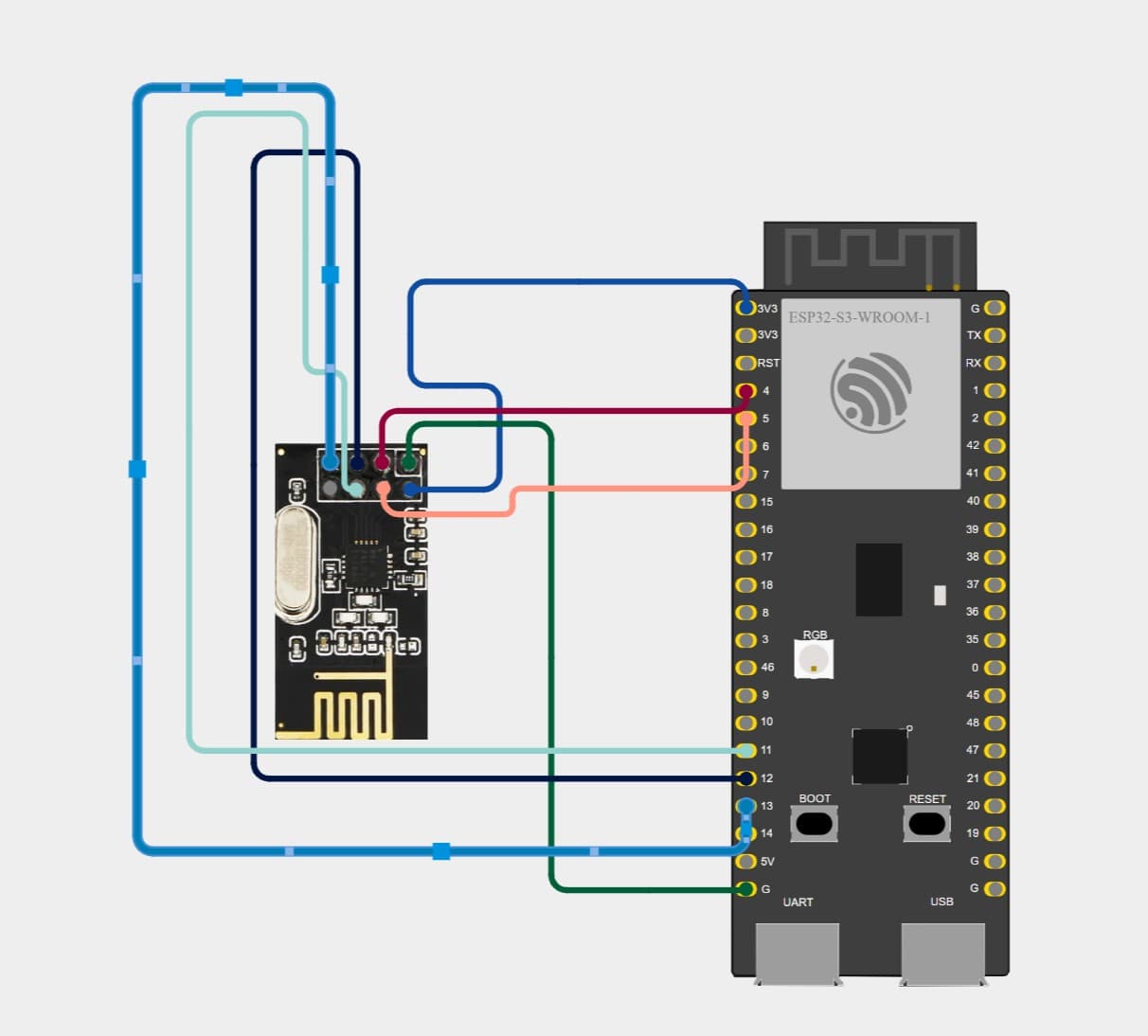
Circuit Connections
Use these connections on both Device A and Device B:
Use GPIO numbers, not physical header positions. Verify the pin labels on your specific NRF module and ESP32-S3 board.
Connect the capacitors across NRF VCC and GND, close to the module:
Electrolytic capacitor positive terminal → 3.3 V.
Electrolytic capacitor negative terminal → GND.
Ceramic capacitor → Across the same VCC and GND connections.
Keep SPI wires short and maintain a common ground between the ESP32-S3 and the NRF power supply.
Never connect a bare NRF module’s VCC directly to 5 V. An adapter may accept 5 V at its input only if it is designed to regulate that voltage to the required radio supply.
Firmware and Software
The firmware is written in Arduino C++ for ESP32-S3 and uses:
Arduino-ESP32: Microcontroller, Wi-Fi, and networking support.
RF24 by TMRh20: Controls the NRF module through SPI.
WebServer: Serves the chat page and local HTTP endpoints.
HTML, CSS, and JavaScript: Provides the phone interface.
The interface is stored in the firmware and served directly by the ESP32-S3. It does not depend on externally hosted scripts, fonts, or internet services.
Both boards use the same firmware, with different node settings:
Both devices can use the same page address because each phone joins a separate local network.
Change the default password in config.h before regular use.
Getting Started
Install the esp32 board package by Espressif Systems in Arduino IDE.
Install RF24 by TMRh20 through Library Manager.
Open the supplied TrailChat.ino sketch with its supporting header files.
Select the appropriate ESP32-S3 board and upload port.
Set NODE_ID to 0 and upload to Device A.
Set NODE_ID to 1 and upload to Device B.
Power both devices and open Serial Monitor at 115200 baud.
Connect each phone to its corresponding device’s Wi-Fi network.
When the phone reports that the network has no internet, choose to stay connected.
Open http://192.168.4.1/ in a browser.
Test a short message in each direction before trying a photo or increasing distance.
Phone Chat Interface
The local interface provides:
A message input area and send button.
A photo-selection option.
Separate styling for sent and received content.
Local NRF detection and recent peer-connectivity status.
Transfer progress and completion or failure feedback.
A save option for available photo previews.
Each device accepts one connected phone at a time.
Keep the page open during transfers and send one item at a time for the most predictable operation.
The current working firmware keeps the Wi-Fi names visible. Automatic hiding during connection is disabled. An optional setting can hide the network from boot, requiring the phone to join it manually using its exact name and password.
Photo Transfer
Large smartphone photos are reduced before transmission. The browser resizes the image, converts it to JPEG, and adjusts quality to fit the transfer limit.
Maximum transmitted photo size: 24 KiB, or 24,576 bytes.
Image resizing: The browser tries longest-edge sizes from 480 down to 160 pixels.
Transmission: The JPEG is divided into small packets and reassembled by the receiving device.
Display: The receiving phone retrieves the completed preview from its ESP32-S3.
This feature is designed for small photo previews, rather than original-resolution images, video, or live streaming.
Transfer time depends on image size, interference, and packet retries. Photos generally take longer to transfer than short text messages.
Packet Reliability and Delivery
The NRF configuration uses a 250 kbps raw radio data rate and 32-byte radio payloads.
In this protocol, a 9-byte application header leaves 23 bytes for content in each data packet. The raw radio rate is different from the final messaging throughput.
The firmware combines hardware acknowledgements with application-level confirmation. It:
Retries packets when the required receipt is missing.
Tracks fragment order.
Handles repeated fragments.
Reassembles the complete message or photo.
Checks the completed transfer using CRC32.
Reports success only after receiving final confirmation.
Delivered means the receiving ESP32-S3 accepted and stored the complete message or photo. It does not mean the other person has read it.
CRC verification detects corruption; it does not encrypt or authenticate the content.
Serial Monitor Diagnostics
Serial Monitor helps distinguish different parts of the system:
| Status or Message | Meaning |
| --- | --- |
| NRF detected / NRF=OK | The ESP32-S3 can communicate with its local radio over SPI |
| PEER=ONLINE | A valid packet was recently received from the other device |
| PHONE ASSOCIATED | A phone established its Wi-Fi association |
| PHONE GOT IP | The phone received an address on the local network |
| TX=delivered | The peer confirmed the completed transfer |
| CRC OK | The received content passed the whole-transfer integrity check |
| Transfer failed | The transfer did not obtain the required confirmation |
Local NRF detection alone does not prove that the radio link is working. Confirm peer activity and a successful transfer in both directions.
Range and Outdoor Use
TrailChat explores communication in places where mobile coverage is unavailable.
Possible uses include:
Campsite messaging.
Open-area field demonstrations.
Trekking communication experiments.
Learning about independent radio networks.
A 1 km range is a development goal, not a verified specification of this build.
Actual distance depends on:
The radio modules being used.
Antenna positioning and height.
Power-supply stability.
Nearby wireless interference.
Trees and wet vegetation.
Rocks, hills, and the path between devices.
Mountain terrain can block the radio link. The presence of an external antenna does not guarantee communication through obstacles.
Test the system progressively outdoors and measure successful transfers in both directions before describing its usable range.
Current Limitations
Text Limit: 800 UTF-8 bytes per message. Some characters and emoji occupy multiple bytes.
Temporary History: Each device retains the last 12 completed message entries in RAM.
Limited Photo Storage: Only the latest sent and latest received photo are retained per device.
Power Loss: Restarting a device clears its stored history.
Offline Peer: Messages are not queued for automatic delivery when the peer returns.
Radio Privacy: The current NRF payloads have no encryption or sender authentication, although local Wi-Fi is password protected.
Range: Reliable mountain or forest coverage has not been established.
Save received photos on the phone before they are replaced by newer ones.
What This Project Demonstrates
TrailChat combines embedded programming, SPI communication, local web interfaces, radio packet transfer, image compression, and integrity checking in one practical build.
It demonstrates how smartphones can become the interface for a separate radio system, allowing a conversation to operate without an internet connection while making the link’s status and limitations visible to the user.
Project Code and Build Files
The firmware package is ESP32S3_NRF24_TrailChat.zip.
It contains:
The ESP32-S3 firmware.
Device configuration files.
The browser-based chat interface.
Wiring instructions.
Setup and upload guidance.
Troubleshooting notes.
Validation details.
Build both devices, confirm communication at short distance, and then test the range in your intended environment.