Back to Hub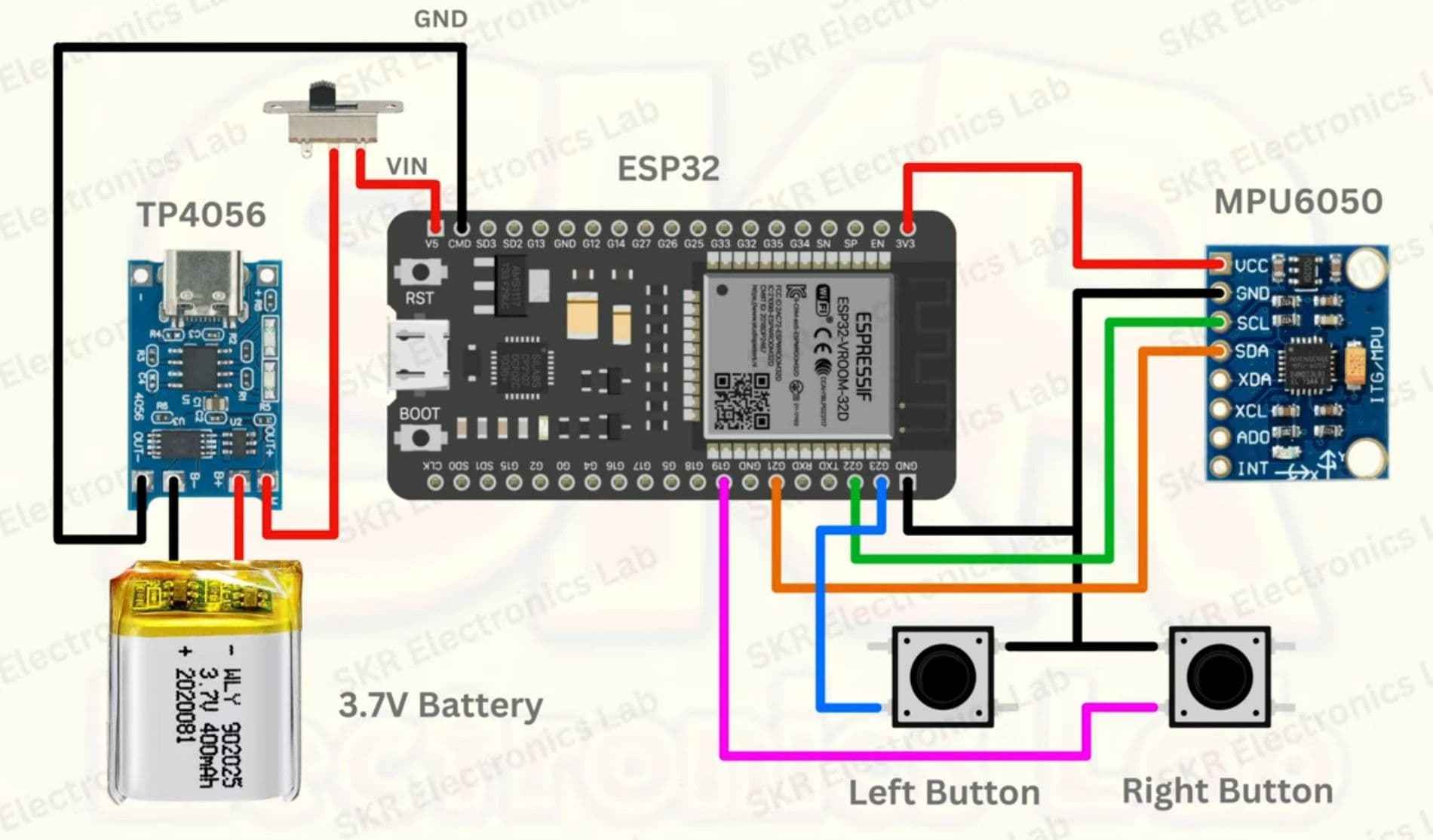
They said, "Just use a normal mouse." So I built one that works... in the air. 🖐️🖱️
September 6, 2026 Watch Tutorial
Wiring Schematic
Source Code
Get full C++ & Python code + lifetime access
Step-by-Step Build Instructions
Project Overview
The ESP32 BLE Motion & Surface Mouse is an embedded human-interface project that converts an ESP32 microcontroller into a standalone Bluetooth Low Energy (BLE) Human Interface Device (HID) using an MPU6050 6-axis inertial measurement unit and tactile switches.
The system acts as a standard wireless mouse without needing custom receiver dongles, companion software, or mobile applications. When powered, the ESP32 broadcasts a standard BLE HID peripheral profile. Any host device—including Android smartphones, iPhones, Windows PCs, Linux workstations, or MacBooks—can pair directly via system Bluetooth settings.
The firmware reads high-speed angular velocity (gyroscope) or linear acceleration forces from the MPU6050 over an I2C bus running at 400 kHz. These inertial vectors are conditioned through zero-motion hardware calibration offsets, filtered through a software deadzone to eliminate stationary cursor jitter, scaled for target sensitivity, and transmitted as HID mouse delta packets (move(x, y)) alongside debounced hardware click events.
This project introduces:
- ESP32 BLE HID Emulation (
BleMouse.h) - I2C Bus Communication & Clock Scaling (
Wire.h)
Hardware Required
- ESP32 Dev Board