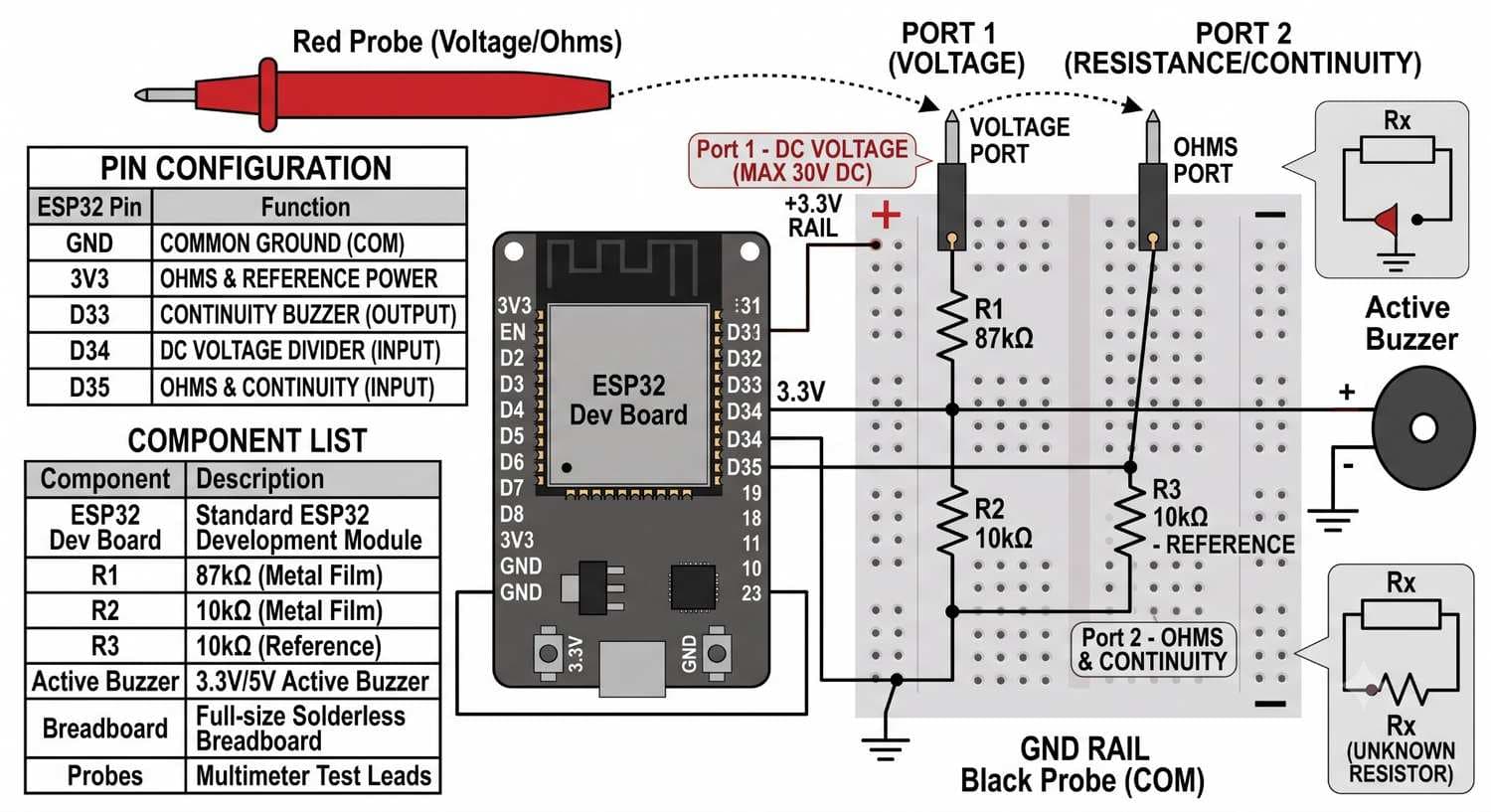
In this project, we build a custom digital multimeter using an ESP32 that features a stunning, premium web dashboard[cite: 3]. Instead of relying on a tiny physical screen, the ESP32 hosts a WiFi Access Point and serves an interactive web interface directly to your phone or computer[cite: 1, 3].
The multimeter is designed with a simplified 2-wire setup, where you leave the black probe in Ground and move the red probe between designated ports on your breadboard[cite: 5]. The system is capable of measuring DC Voltage up to approximately 30V, calculating Resistance (Ohms), and testing Continuity with an active buzzer[cite: 3].
This project beautifully demonstrates the integration of hardware voltage dividers, analog-to-digital conversion (ADC), and full-stack web development (HTML/CSS/JS) running entirely on a single microcontroller[cite: 1, 3, 4, 6, 7].
🛠 Components Required
ESP32 Development Board[cite: 2]
100kΩ Resistor[cite: 2]
10kΩ Resistors (x2)[cite: 2]
Active Buzzer[cite: 2]
Breadboard[cite: 2]
Long Red Wire (Red Probe)[cite: 2]
Long Black Wire (Black COM Probe)[cite: 2]
Jumper Wires[cite: 2]
Hardware Required
ESP32
Computer/Laptop
Wi-Fi enabled device (Phone/Laptop) for viewing dashboard[cite: 3]
📚 Software Required
Arduino IDE[cite: 3]
ESP32 Board Manager[cite: 3]
Core Libraries Used (Built-in):
WiFi.h
WebServer.h
⚙️ Working Principle
The ESP32 hosts a local WiFi Access Point named "ESP32-Multimeter"[cite: 1, 3].
When connected, the ESP32 serves a premium HTML/CSS dashboard mimicking a real multimeter dial[cite: 3].
For Voltage, a 100kΩ and 10kΩ voltage divider safely scales down voltages (up to 30V) for the ESP32's 3.3V ADC limit[cite: 3].
For Resistance, a 10kΩ reference resistor is used in a divider circuit to calculate the value of unknown resistors[cite: 3].
For Continuity, the system checks for a short circuit (less than 50 ohms) and physically triggers an active buzzer[cite: 1, 3].
The dashboard's JavaScript polls the ESP32 every 400ms to fetch the latest readings and update the digital screen instantly[cite: 6].
🚀 Features
✔ Premium Web Dashboard UI[cite: 3]
✔ Real-Time Data Polling[cite: 6]
✔ DC Voltage Measurement (0 - 30V)[cite: 3]
✔ Resistance Measurement (Ω, kΩ, MΩ)[cite: 1, 3]
✔ Continuity Tester with Active Buzzer[cite: 3]
✔ Simplified 2-Wire Hardware Setup[cite: 5]
✔ Interactive On-Screen Rotary Dial[cite: 3, 4]
✔ No External Internet Connection Required[cite: 3]
• Implement Current (Amps) measurement using a shunt resistor
• Add an OLED display as a physical backup to the web dashboard
• Integrate a battery circuit to make the ESP32 fully portable
• Add automatic data-logging to a CSV file on the web server
• Develop an auto-ranging feature for resistance
❗ Common Issues & Solutions
1. High Voltage Danger
Reason:
Attempting to measure AC mains or high DC voltages[cite: 3].
Solution:
Never measure AC voltage with this setup; it will fry the ESP32 and is highly dangerous[cite: 3].
Ensure voltage is strictly ~30V DC or below[cite: 3].
2. Web Dashboard Not Loading
Reason:
Not connected to the correct WiFi network.
Solution:
Ensure your device is connected to the "ESP32-Multimeter" Access Point[cite: 3].
Navigate exactly to http://192.168.4.1 in your browser[cite: 3].
3. Inaccurate Voltage or Resistance Readings
Reason:
Tolerance variations in your physical 10kΩ and 100kΩ resistors.
Solution:
Tweak the VOLTAGE_CALIBRATION and RESISTANCE_CALIBRATION float variables in the C++ code to match a commercial multimeter[cite: 1].
4. Buzzer Does Not Sound
Reason:
Probes are plugged into the wrong port, or wiring is backwards[cite: 5].
Solution:
Ensure the buzzer's positive pin is on ESP32 Pin 33 and negative on GND[cite: 3, 5].
Ensure your Red probe is plugged into the Resistance/Continuity port (Pin 35)[cite: 5].
📖 Learning Outcomes
After completing this project, you will learn:
• How to build and calculate Voltage Dividers[cite: 3]
• Analog-to-Digital Conversion (ADC) on the ESP32[cite: 1, 3]
• Hosting a standalone Web Server and Access Point via C++[cite: 1, 3]
• Embedding raw HTML, CSS, and JavaScript inside Arduino code[cite: 1, 3]
• Real-time asynchronous data fetching using JavaScript fetch API[cite: 6]
• Electronic calibration techniques in software[cite: 1]
🎯 Conclusion
This project is a massive step up from standard beginner tutorials, beautifully combining hardware circuitry, embedded C++, and modern frontend web design. It results in a highly practical tool that you can actually use for future builds. It proves that microcontrollers like the ESP32 are powerful enough to act as both the brain of a measurement device and the host of a rich, interactive user interface!
Breadboard
Jumper wires
3 10k ohm resistor
1 87k ohm resistor
1 buzzer
USB Cable
⚡ I built my own DIY Digital Multimeter using Arduino! 🤯 | Aditya Invents Blueprint