Get full C++ & Python code + lifetime access
The Dracula OLED Music Visualizer is an advanced OLED animation project that recreates synchronized visual effects inspired by the song "Dracula" by JENNIE and Tame Impala.
The system displays dynamic lyrics, animated backgrounds, and visual effects on a 0.96-inch SSD1306 OLED display. Multiple visual scenes automatically switch according to a predefined timeline, creating the illusion of a music-synchronized OLED animation.
This project demonstrates advanced graphics programming, animation techniques, and OLED rendering on microcontrollers.
Words appear on the OLED according to a carefully timed sequence.
The visualizer includes:
Several text effects are included:
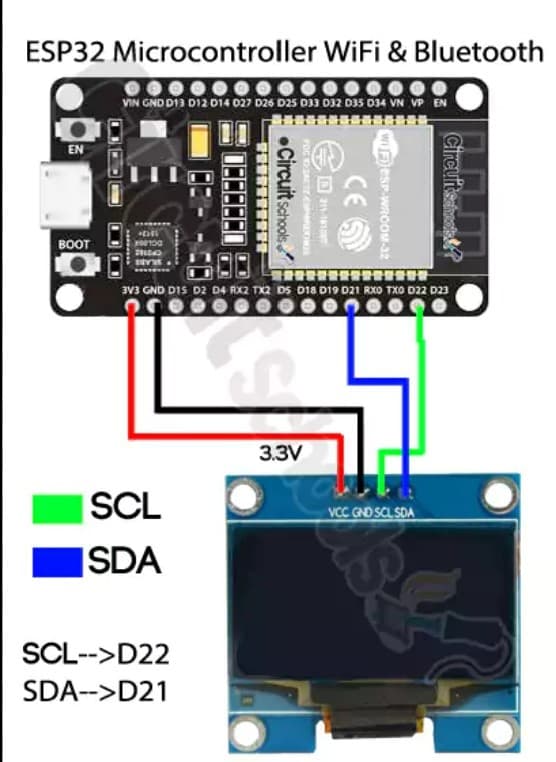
128×64)128×64I2CSSD1306| OLED Pin | ESP32 Pin |
| -------- | --------- |
| VCC | 3.3V |
| GND | GND |
| SDA | GPIO21 |
| SCL | GPIO22 |
OLED VCC → 3.3V
OLED GND → GND
OLED SDA → GPIO21
OLED SCL → GPIO22
Verify your OLED I2C address before uploading the code. Most displays use 0x3C.
Install the following libraries through Arduino IDE Library Manager:
Connect the ESP32 board to your computer.
Open the Arduino IDE.
Install all required libraries.
Select:
ESP32 Dev ModuleUpload the sketch.
After reset, the animation sequence will start automatically.
The project contains a predefined lyric timeline.
Each lyric contains:
The visualizer dynamically switches between animation modes based on the active lyric.
Every frame:
This process creates smooth real-time animation.
Check the I2C address and verify SDA/SCL wiring.
Confirm the OLED uses the SSD1306 driver and receives 3.3V.
Ensure all required Adafruit libraries are installed.
Use an ESP32. Arduino UNO does not have sufficient memory for this project.
After completing this project you will understand:
The Dracula OLED Music Visualizer is a high-performance graphics project that transforms a small SSD1306 OLED display into a dynamic animation engine. By combining timed lyrics, multiple animation systems, and visual effects, the project creates an immersive music-inspired OLED experience using an ESP32 microcontroller.